
Three colleagues smiling at a shared office desk, representing a supported workplace team

What Does an MHFA Lead Do? Role, Responsibilities and Why It Matters

Quick answer: an MHFA Lead is the named person responsible for coordinating and maintaining the quality of an organisation’s Mental Health First Aid provision. They make sure Mental Health First Aiders understand their role and boundaries, act as the escalation point when concerns arise, run regular MHFA meetings, and turn themes from MHFA conversations into action across the organisation. Under MHFA England’s new Workplace Mental Health First Aid Standards, every organisation with MHFAiders is required to have a designated lead.

Training Mental Health First Aiders is only the first step. Without someone coordinating them, MHFAiders end up working in isolation, unsure of their limits, with no one to turn to after a difficult conversation. In our experience, the MHFA Lead is the difference between mental health first aid that works and mental health first aid that’s just a list of names on the intranet.

What is an MHFA Lead?

The MHFA Lead is the named point of responsibility for an organisation’s Mental Health First Aid provision. Their job is to make sure mental health first aid is delivered safely, consistently and within agreed boundaries.

They set the quality and standards, helping MHFAiders understand their role, their limits and their responsibilities. And when boundaries are crossed, for example if there are concerns about an MHFAider overreaching their role or confidentiality being breached, the MHFA Lead is the correct escalation point. They may liaise with HR or senior leaders as part of this. That protects the MHFAider, the person being supported and the organisation, and avoids informal or inappropriate escalation outside the agreed structure.

What do the new MHFA England standards say?

MHFA England’s Workplace Mental Health First Aid Standards, published in October 2026, make the lead role a requirement. The standards say organisations should:

  • Appoint a designated MHFA lead to oversee the MHFAider network and act as the internal point of contact, with clear ownership and enough time to do the role.
  • Give MHFAiders regular peer support and debriefs, with protected time within working hours.
  • Hold regular wellbeing check-ins with MHFAiders to spot signs of fatigue or emotional overload.
  • Let MHFAiders pause or step down at any time, without penalty or pressure.

In smaller organisations, the standards ask for a single named point of contact that MHFAiders and colleagues know to go to. You can read more about how many MHFAiders you need in our guide: How many Mental Health First Aiders does a workplace need?

The 8 responsibilities of an MHFA Lead
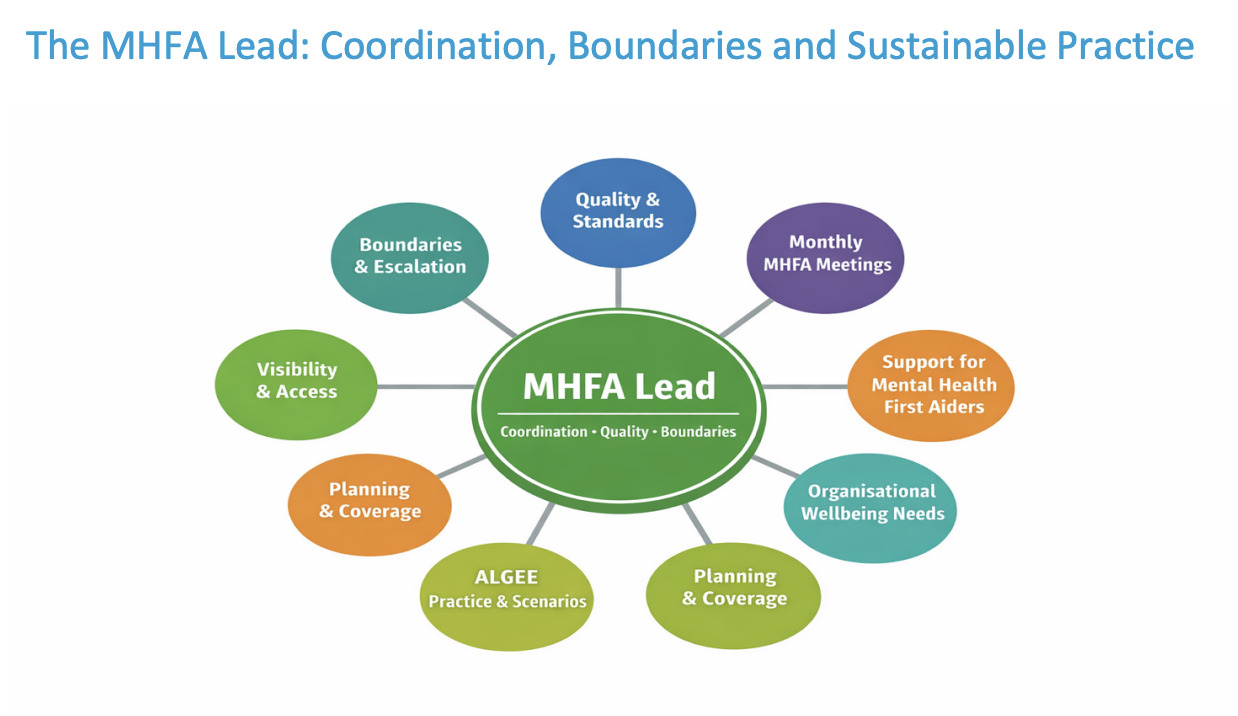
Diagram of the MHFA Lead role: boundaries and escalation, quality and standards, monthly MHFA meetings, support for Mental Health First Aiders, organisational wellbeing needs, ALGEE practice and scenarios, planning and coverage, and visibility and access
The MHFA Lead role, by Richie Perera, Mental Health & Life

1. Boundaries and escalation

The MHFA Lead makes sure MHFAiders stay within their role and provides a clear route for escalating concerns when boundaries are reached. MHFAiders are not therapists, and they need to know exactly what to do and who to go to when a situation goes beyond first aid.

2. Quality and standards

They maintain consistent, safe practice across the organisation, so support is delivered in line with agreed guidance, whichever MHFAider someone speaks to.

3. Monthly MHFA meetings

The MHFA Lead brings MHFAiders together at least once a month. These meetings give a safe, structured space to share themes from conversations (never personal details), discuss what’s happening across the organisation, and identify gaps, risks and opportunities to improve.

4. Support for Mental Health First Aiders

They identify what support MHFAiders need to carry out their role well, without breaching confidentiality. Supporting others can take its toll, and the lead makes sure no MHFAider is carrying that alone.

5. Organisational wellbeing needs

Through shared themes from MHFA conversations, the MHFA Lead spots emerging wellbeing needs across the organisation. Perhaps workload is rising in one department, or a restructure is causing anxiety. This turns mental health first aid into preventative action across the workforce, rather than a series of isolated one-to-one conversations.

6. ALGEE practice and scenarios

Not every MHFAider will be active at the same time, and that’s expected. The MHFA Lead makes sure everyone regularly practises ALGEE, the MHFA action plan, through scenarios. This keeps less active MHFAiders confident and ready if a conversation comes their way.

7. Planning and coverage

This responsibility has two sides. The MHFA Lead plans who is active over the coming month so there’s always appropriate access to mental health first aid across the organisation. And they recognise when someone needs to step back to protect their own capacity and wellbeing, for example during a busy project or a difficult time in their own life. Effective mental health first aid depends not only on support being available, but on the people providing it being able to sustain it.

8. Visibility and access

The MHFA Lead makes sure people know who the MHFAiders are and how to reach them. That includes clear guidance on when MHFAiders wear lanyards to show they’re available to talk right now, and how colleagues can approach someone for an immediate conversation or book a time.

What a monthly MHFA meeting can look like

A simple structure for a one-hour monthly meeting led by the MHFA Lead:

  1. Check-in (10 minutes): how is everyone doing? Does anyone need support or to step back for a while?
  2. Themes (15 minutes): what themes are coming up in conversations? No names or personal details, only patterns.
  3. Organisational view (10 minutes): what might those themes say about wellbeing needs across the organisation, and what could be done about them?
  4. ALGEE practice (15 minutes): work through a scenario together to keep skills fresh.
  5. Planning (10 minutes): who is active next month, lanyard rotas, and any gaps in coverage across teams, sites or shifts.

What the MHFA Lead role is not

The MHFA Lead does not replace line management, HR responsibilities or professional support services such as occupational health or an Employee Assistance Programme. They don’t manage individual cases. The role exists to coordinate mental health first aid safely and effectively, with appropriate boundaries, escalation and organisational learning.

Who should be your MHFA Lead?

There’s no single right answer, but a good MHFA Lead is usually:

  • A trained Mental Health First Aider, so they understand the role from the inside.
  • Senior enough to be heard, with a direct line to HR and leadership when something needs escalating.
  • Given real time for the role, not just expected to fit it around everything else.
  • Trusted and approachable, someone MHFAiders feel comfortable being honest with.

Frequently asked questions

Is an MHFA Lead a legal requirement?

No. Mental health first aid itself isn’t a legal requirement in the UK yet. However, a designated MHFA lead is a required part of MHFA England’s new Workplace Mental Health First Aid Standards, which are now the benchmark for good practice.

Does a small organisation need an MHFA Lead?

Yes, even if it’s a small part of someone’s role. The standards ask smaller organisations to have a single named point of contact. We’d recommend at least two MHFAiders plus a lead, so MHFAiders can support each other and there’s always cover.

Can the MHFA Lead also be an MHFAider?

Yes, and it often works best that way. Just make sure they have enough time for both, and someone they can go to for their own support.

How often should MHFA meetings happen?

We recommend at least monthly. The standards require regular peer support and debriefs at a frequency that reflects the demands of the role, so busier organisations may need to meet more often.

Need help setting up your MHFA provision?

We help organisations build mental health first aid that works, from training your first MHFAiders to setting up the lead role, meetings and policies around them. Request a quote for a private course for your team, find out about our MHFA consultancy, or call us on 020 3984 9825.
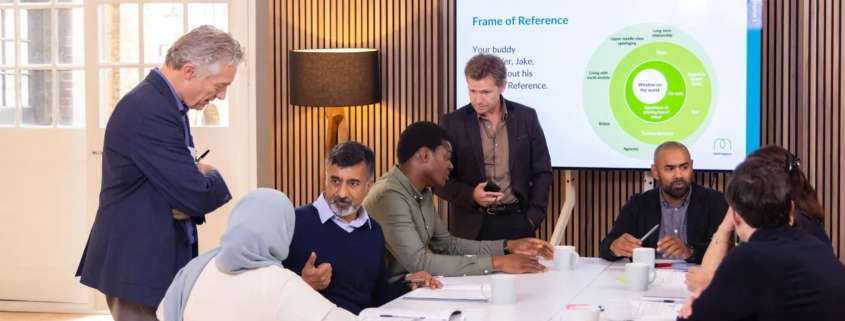
A group of learners discussing an exercise during an MHFA England Mental Health First Aid course led by Richie Perera

The Maths Don’t Add Up: Why 1 in 50 Mental Health First Aiders Isn’t Enough

In October 2026, MHFA England published the first ever Workplace Mental Health First Aid Standards. Let me say this first, and clearly: this is a big step forward, and I welcome it. I’m an MHFA England Instructor Member, I’ve trained over 1,000 people, and I have huge admiration for the organisation and the work it does. Employers now have a framework for what good mental health first aid looks like, and that’s long overdue.

But there’s one part of the standards I want to open up for discussion: the numbers. Organisations with more than 50 employees are now required to have at least one Mental Health First Aider (MHFAider) for every 50 employees, with one in 25 as an aspirational benchmark. When I first read that, my honest reaction was: the maths don’t add up.

This isn’t a criticism. It’s a conversation I think we need to have, and I’d love you to be part of it.

Where does 1 in 50 come from?

The standards say the 1 in 50 ratio is “in line with physical first aid provision”. That’s the only reasoning given. There’s no data, no research and no explanation of how the number was reached, for either 1 in 50 or 1 in 25.

For physical first aid, the Health and Safety Executive suggests around one first aider for every 50 employees in higher-hazard workplaces, such as factories and warehouses. For low-hazard workplaces like offices, it’s one for every 100. In other words, the physical first aid ratio is based on how likely people are to get injured at work.

So my question, asked with genuine respect, is this: what evidence is the mental health first aid ratio based on? Because mental health doesn’t work like a cut finger.

Mental health first aid isn’t physical first aid

With physical first aid, something happens. Someone trips, cuts their hand or collapses. Everyone can see it, the first aider steps in, and in most cases it’s over in a matter of minutes.

Mental health doesn’t announce itself like that. People wear masks. They smile in meetings, hit their deadlines and say “I’m fine” when they’re anything but. A lot of mental ill health in the workplace is completely invisible until someone notices the signs or finally feels safe enough to reach out.

And when they do, it’s rarely a five-minute job. A supportive conversation can easily take an hour. It often needs a follow-up, sometimes several. It can be emotionally heavy, and it stays with the MHFAider long after the conversation ends. In 2020, I received a call from a 19-year-old in Pembrokeshire who was preparing to take his own life. Staying with him on the phone, keeping him safe and getting the police and ambulance to him wasn’t a quick fix. That is the reality of mental health first aid at its most intense, and it looks nothing like putting on a plaster.

Copying a ratio from physical first aid and applying it to mental health first aid assumes the two are alike. They’re not.

Let’s do the maths

Here’s what we know about mental health in the UK right now:

  • Around 1 in 6 people experience a common mental health condition, such as anxiety or depression, in any given week (Mind).
  • 8.89 million people in England were prescribed antidepressants in 2024/25, roughly 1 in 6 of the population (NHS Business Services Authority).
  • 6,162 suicides were registered in England and Wales in 2025, with rates at their highest level in around 25 years (ONS).

Now take a team of 50. If 1 in 6 are experiencing a common mental health condition this week, that’s around eight people. Under the minimum standard, those eight people share one MHFAider.

The standards themselves say MHFAiders use their skills two to three times a week on average. So even if everything goes perfectly, one MHFAider can only reach a fraction of the people who might need them. Not everyone who is struggling will want support, of course, but the gap is still huge.

Now imagine being that one person. You spend half a day supporting a colleague, then try to catch up on your own work. The next day, someone else needs you. And the day after that. You’re the only MHFAider for 50 people, so there’s no one to hand over to and no one to talk to about how it’s affecting you. That’s not a sustainable role. That’s a recipe for burnout.

Mental health first aid needs a team

One of the most important things I teach on every course is self-care. Mental health first aid isn’t only about looking after other people. It’s about looking after yourself too. It’s the oxygen mask rule: you put yours on first, or you can’t help anyone else.

That’s why I believe mental health first aid, done properly, needs a team, even in the smallest organisation. At a minimum, that means:

  • At least two MHFAiders, so they can support each other and there’s always cover.
  • The freedom to step back when their workload gets too much, a big project lands or life gets in the way, knowing someone else is there.
  • An MHFA Lead to hold it all together.

What a good MHFA Lead does

The standards rightly require a designated MHFA lead. In my experience, this role is the difference between mental health first aid that works and mental health first aid that’s just a list of names on the intranet. A good MHFA Lead:

  • Sets the boundaries, so MHFAiders understand their role and its limits, and acts as the correct escalation point if there’s overreach or a breach. This protects the MHFAider, the person being supported and the organisation.
  • Runs monthly MHFA meetings, where MHFAiders share themes (never personal details), support each other and spot gaps and risks.
  • Keeps skills sharp by practising ALGEE through scenarios, especially for MHFAiders who haven’t had many conversations recently.
  • Plans who is active each month and recognises when someone needs to step back, protecting people from burnout.
  • Makes MHFA visible and accessible, including when MHFAiders wear lanyards to show they’re available and how people can book a conversation.
  • Turns conversations into action, identifying emerging wellbeing needs across the organisation so it can respond with prevention, not just one-to-one support.

None of that works with one MHFAider for every 50 people. It needs a network. I’ve written a full guide to the role here: What does an MHFA Lead do?

So what number would I suggest?

My recommendation is one trained person for every five employees. At that level, everyone has someone they know and trust close by. MHFAiders can share the load, support each other and step back when they need to. And support is available across every team, site and shift.

I know that sounds like a lot. It doesn’t have to happen overnight. Start with the standards, build towards one in 25, then keep going. I’ve set out a practical phased plan in our guide: How many Mental Health First Aiders does a workplace need?

What I’m not saying

I’m not saying the standards are wrong to exist. They’re a huge step in the right direction, and every employer should be working towards them. I’m also not saying more MHFAiders replace professional help, a manager’s duty of care, occupational health or an Employee Assistance Programme. MHFAiders are a first point of contact, not therapists.

What I am saying is that if we want mental health first aid to be delivered safely, sustainably and well, the minimum needs to reflect the reality of mental health at work today, not the reality of a first aid kit.

Let’s talk

I’d genuinely love to hear your views on this, whether you agree with me or not.

  • If you’re an MHFAider, how many people are you there for, and does it feel manageable?
  • If you’re an employer, what ratio do you have, and how did you decide on it?
  • And to MHFA England, an organisation I’m proud to be part of: I’d welcome the chance to understand the evidence behind 1 in 50 and 1 in 25.

Share your thoughts with me on LinkedIn, or get in touch. And if you’d like help building a mental health first aid team that works for your organisation, find out about private courses for employers.

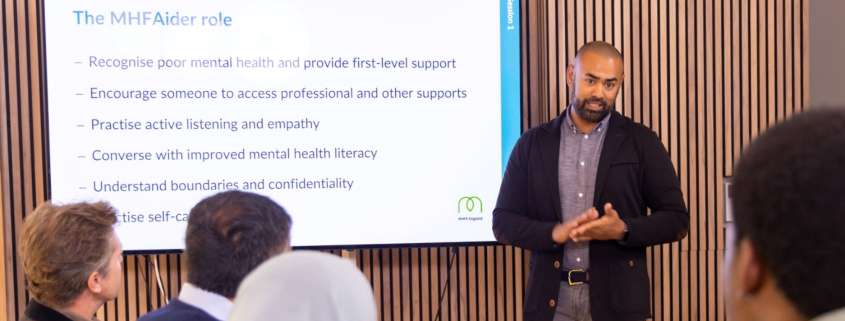
Richie Perera, MHFA England Instructor Member, explaining the Mental Health First Aider role to a group of learners

How Many Mental Health First Aiders Does a Workplace Need? (2026 Guide)

Quick answer: under MHFA England’s new Workplace Mental Health First Aid Standards (October 2026), organisations with more than 50 employees should have at least one Mental Health First Aider (MHFAider) for every 50 employees, and should aim for one for every 25. Smaller organisations should make sure every colleague can easily reach at least one MHFAider. In our view, even 1 in 25 isn’t enough, and we explain why below.

If you’re an HR manager, business owner or health and safety lead, this guide covers what the official standards say, what the law requires, how many people your organisation needs, and how to put it into practice without it becoming a tick-box exercise.

What the new MHFA England standards say

On 6 October 2026, MHFA England published the first Workplace Mental Health First Aid Standards, developed with members of the Association of Mental Health First Aiders, employers and instructors. Some parts are marked as required and others as recommended best practice. On numbers, they say:

  • Required: organisations with more than 50 employees should have at least one MHFAider for every 50 employees, in line with physical first aid provision.
  • Recommended: work towards one MHFAider for every 25 employees.
  • Smaller organisations: rather than a ratio, make sure at least one MHFAider is easily reachable by every colleague. For a very small team, one well-supported MHFAider can be enough.
  • Multiple sites, teams and shifts: have an MHFAider at each location, and use a risk assessment to decide where extra MHFAiders are needed.
  • Who to choose: MHFAiders should come from across the organisation, including managers and senior leaders, and reflect the diversity of your workforce.

The standards also require MHFAiders to keep their skills current with an MHFA Refresher or a full Mental Health First Aid course every three years. MHFA England’s guide for employers also recommends retaking the full course every six years.

Is mental health first aid a legal requirement?

Not yet. There is no UK law requiring employers to have Mental Health First Aiders. However, employers do have a legal duty to assess their first aid needs, and the Health and Safety Executive’s guidance says that, after that assessment, employers might decide it would be beneficial to have people trained to recognise and respond to mental health issues. Employers also have wider duties to manage work-related stress and to make reasonable adjustments for employees with mental health conditions.

MHFA England is campaigning for mental health first aid to become a legal requirement alongside physical first aid. Until that happens, the new standards are the clearest benchmark of what good looks like. This guide is general information, not legal advice.

How many MHFAiders does your organisation need?

Here’s what the numbers look like for different sizes of organisation, alongside our own recommendation of one in five (explained in the next section).

Number of employeesMinimum (1 per 50)Recommended (1 per 25)Our recommendation (1 per 5)
101 (easily reachable)12
251 (easily reachable)15
501210
1002420
25051050
5001020100

These are starting points. Adjust them for your sites, shift patterns, remote and hybrid workers, and higher-pressure roles. If people work nights or weekends, make sure there’s an MHFAider available during those hours too.

Our view: why 1 in 50 isn’t enough

By Richie Perera, MHFA England Instructor Member and founder of Mental Health & Life

The new standards are a big step forward, and I welcome them. But I believe the minimum ratio is far too low to deliver support safely and well.

According to Mind, one in four people in England will experience a mental health issue each year, and around one in six experience a common mental health condition such as anxiety or depression in any given week. In a team of 50, that could mean eight or more people struggling at any one time, with a single MHFAider as their point of contact.

That’s a heavy load for one person who also has a day job. It leaves no cover when they’re on leave, off sick or on a different shift. It also assumes colleagues feel comfortable approaching that one person, which isn’t always the case.

That’s why I recommend employers work towards one trained person for every five employees. At that level, everyone has someone they know and trust nearby, MHFAiders can share the load and support each other, and help is available across every team, site and shift.

I’ve set out my full reasoning, including where the 1 in 50 figure comes from and why mental health first aid needs a team, in The Maths Don’t Add Up: Why 1 in 50 Mental Health First Aiders Isn’t Enough.

How to get there without doing it all at once

One in five can sound like a lot. For a 100-person organisation it means 20 people. You don’t have to do it in one go. A phased plan works well:

  1. Year one: meet the recommended 1 in 25 with a core group of MHFAiders trained on the 2-day MHFA England Mental Health First Aider course, including at least one at every site.
  2. Year two: add more MHFAiders and train line managers as MHFA Champions, so support is spread across every team.
  3. Year three: reach one in five, and keep everyone current with the MHFA Refresher.

Making your Mental Health First Aiders effective

Numbers matter, but MHFAiders only work well when they’re properly supported. The standards and MHFA England’s guide for employers highlight a few essentials:

  • Appoint an MHFA lead with clear ownership and enough time to do the role. Read what a good MHFA Lead does.
  • Write a short MHFA policy covering roles, boundaries, confidentiality and how to escalate.
  • Have a clear escalation process for crisis situations such as suicide risk or self-harm. MHFAiders are not therapists, and they need to know exactly who to call.
  • Give protected time for training, debriefs and peer support.
  • Look after your MHFAiders with regular check-ins, so supporting others doesn’t take a toll on them.
  • Make them visible through induction, signage and internal communications, so people know who they are and how to reach them.

Frequently asked questions

Do small businesses need a Mental Health First Aider?

It isn’t a legal requirement, but the standards apply to employers of all sizes. For organisations under 50 people, the aim is that every colleague can easily reach at least one MHFAider. We’d recommend at least two, so there’s always cover.

How long does Mental Health First Aid training take?

The MHFA England Mental Health First Aider course takes two days, or the equivalent spread across online sessions. The MHFA Champion course is one day, and the Refresher is half a day.

How often do Mental Health First Aiders need refresher training?

Every three years, through an MHFA Refresher or a full Mental Health First Aid course. This is a required part of the new standards.

Can we train our team together?

Yes. A private course trains up to 16 of your people together, online or at your workplace anywhere in the UK, on dates that suit you. It’s often more cost-effective than booking individual places.

Get your workplace covered

Whether you’re starting with your first MHFAiders or building towards one in five, we can help you plan the right mix of training for your organisation. Request a quote for a private course for your team, or call us on 020 3984 9825.